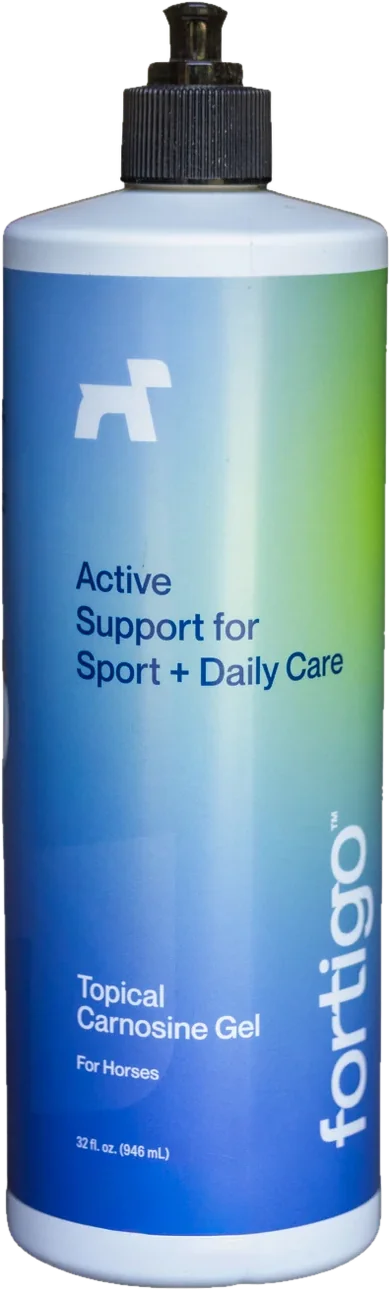
Topical carnosine for animal use, featured here for equine performance and care.
EQUINE/FORTIGO
EQUINE RESEARCH • PEER-REVIEWED • 2021
THE HORSE GAVE RESEARCHERS A WAY TO LOOK INSIDE THE MUSCLE.
A controlled equine study directly measured muscle carnosine after topical application.
006 / THE STUDY
Transdermal delivery of carnosine into equine skeletal muscle
Journal
Comparative Exercise Physiology
Year
2021
Design
Randomized, placebo-controlled crossover study
Subjects
10 Thoroughbred racehorses
Application area
Middle gluteal muscle
Measurement
Muscle biopsies
BASELINETopical carnosine or placebo applied
30 MINMuscle biopsy
60 MINMuscle biopsy
120 MINMuscle biopsy
THE MEASURED FINDING
≈ +35%at 30 minutes
≈ +46%at 60 minutes
Intramuscular carnosine concentration was higher after carnosine application than after placebo at 30 and 60 minutes.
At 120 minutes, the difference from placebo was not statistically significant.
RELATIVE DIFFERENCE VS PLACEBO
Conceptual view of reported relative differences. Not raw concentration data. 120-min position is illustrative only.
WHAT DID THEY ACTUALLY PROVE?
The study provides direct evidence that topical application using the tested transdermal system increased measured carnosine concentration in equine skeletal muscle within 60 minutes.
WHAT IT DID NOT TEST
The study did not directly measure racing speed, competition results, athletic performance, soreness, or recovery outcomes.
WHY THIS STUDY MATTERS
Most topical performance claims rely on how a product feels on the skin. This study went further: researchers took muscle biopsies and measured carnosine inside the muscle itself.
That makes the equine study an important piece of evidence in understanding topical carnosine delivery.
HORSES & MUSCLE CARNOSINE
Equine skeletal muscle contains substantial amounts of carnosine, with higher concentrations reported in fast-twitch muscle fibers involved in high-intensity activity.
Sewell DA, Harris RC, Marlin DJ, Dunnett M. “Estimation of the carnosine content of different fibre types in the middle gluteal muscle of the thoroughbred horse.” The Journal of Physiology. 1992.
Choose the product that matches who you're applying it to.
For animal use
How to use Fortigo
01
Apply
Apply Fortigo to the area you want to target.
02
Massage
Massage in thoroughly.
03
Use as directed
Use according to Fortigo product directions and appropriate animal-care guidance.
Daily care • Before activity • After work
Targeted topical application
Apply only according to Fortigo product directions and appropriate animal-care guidance.
Horse • Canine
Fortigo Animal Health
Topical
237 mL
946 mL
For animal topical use only • Not for use on humans
Application is simple. The next question is why topical?
↓
Knowledge hub
Questions about carnosine?
Start with the questions people ask before they understand the science, the products, or the difference between human and animal use.
Animal / Fortigo
Fortigo Animal Health is a topical carnosine-based product for animal use. It is not for use on humans.
Yes. Fortigo is used in the equine category and is the animal-use product featured throughout the horse sections of The Carnosine.
Fortigo is an animal-use topical product. Canine use should follow the current Fortigo product directions and appropriate animal-care guidance. The Carnosine does not claim that horse research automatically proves the same effects in dogs.
The Fortigo products currently featured on The Carnosine are 237 mL and 946 mL.
Apply Fortigo to the area you want to target and massage in thoroughly, following the current product directions and appropriate animal-care guidance.
Current product guidance supports use as part of daily care, before activity or after work. Follow the current Fortigo label for the most accurate instructions.
No. Fortigo is for animal topical use only and is not for use on humans.
Yes. A peer-reviewed 2021 equine study measured intramuscular carnosine after topical application and reported higher muscle carnosine concentrations at 30 and 60 minutes compared with placebo.